.avif)
Learning German in Aachen: Language courses alongside your studies

If you are new to Aachen and want to take your German to the next level, the RWTH Language Center is the place to go. This article shows you which course formats are available, how registration and placement tests work, what the courses cost, and how to realistically fit learning into your schedule alongside lectures, internships, and everyday life.
- The RWTH Language Center offers semester courses at various proficiency levels specifically for students [1].
- Before your first course, you usually have to take a placement test to ensure you are in the right level [3].
- Registration is handled online via the Language Center and is subject to fixed deadlines at the start of the semester [2].
- Costs vary depending on the course type and scope; you can find current prices directly at the Language Center [4].
- Scheduling fixed study times and having a quiet place to retreat will increase your chances of staying on track.
- Language tandems and conversation groups are a free way to supplement your course and practice everyday German.
- Having your own quiet living space with stable Wi-Fi makes learning vocabulary and doing online exercises much easier.
Why is a German course worth it alongside your studies?
Even if your degree program is taught entirely in English, you will quickly realize in Aachen that things can be complicated without German. Whether it's dealing with your landlord, talking to a doctor, ordering at the local bakery, or simply chatting with German fellow students in the cafeteria: it helps everywhere if you can at least communicate the basics. Many international students underestimate at the beginning how much of daily life takes place in German, especially off-campus. A language course is therefore not a tedious chore, but a practical tool that makes settling into the city noticeably easier. Anyone navigating a city like Aachen, with its mix of German, Belgian, and Dutch influences, also benefits from being linguistically flexible. Not least, some degree programs or future internships require a certain language level as proof, so starting a course early pays off later when a certificate is needed. Solid German skills are also an advantage for your future career in Germany—it is best to work on them during your studies rather than putting it off until later.
Which German courses does RWTH specifically offer?
The RWTH Aachen Language Center organizes semester-long German courses specifically tailored to everyday university life [1]. The courses run for an entire semester and are divided into different proficiency levels, ensuring that both absolute beginners and students with advanced knowledge can find a suitable option. In addition to the standard semester courses, which take place once or several times a week, there are also more compact formats available depending on the current offering, focusing more heavily on specific skills such as listening, speaking, or academic writing. The advantage of this structure is that you can combine the courses relatively easily with your class schedule, as they are designed for students from the outset and are intended to avoid conflicts with lecture times. It is important to check the current course offerings each semester, as dates, proficiency levels, and capacities can vary slightly from term to term. If you are coming to RWTH from abroad, you should ideally look at the offerings before arriving in Aachen to realistically assess when and how often a suitable course takes place.
For your orientation, the table below provides an overview of the most important steps toward securing a course spot, from initial information to the actual start of the course.
StepWhat happensWhat to look out for1. Check course offeringsView current semester courses and proficiency levels [1]Offerings change each semester2. Placement testOnline test covering grammar, vocabulary, and listening comprehension [3]Complete early, not just before the registration deadline3. Online registrationRegister via the Language Center [2]Observe fixed deadlines at the start of the semester4. Clarify costsCheck course fees based on the format [4]Inquire about discounts or installment payments in advance5. Course startSemester-long instruction beginsBlock the date firmly in your personal scheduleHow do registration and the placement test work?
Before you can join a German course, you will generally need to take a placement test to determine your current language level [3]. This is useful because otherwise you might end up in a course that is too easy and leaves you unchallenged, or one that is too difficult because the pace is too fast. The test usually covers grammar, vocabulary, and sometimes listening comprehension; it is conducted digitally, so you can complete it comfortably from your room, provided you have a stable internet connection. After the test, you will receive a recommendation regarding which level suits your skills, and you can then register for the corresponding course. The actual registration for German courses is handled online via the RWTH Language Center [2]. Please note: Registration deadlines are strictly tied to the start of the semester and course spots are limited, so you should not wait until the last minute. If you miss the deadlines, you will often have to wait until the next semester or look for an alternative. It is therefore worth marking the registration period in your calendar right at the start of the semester and taking the placement test early so that you do not fall behind when it comes time to register for courses.
How much do German courses cost and who pays for them?
The cost of German courses at the Language Center depends on the chosen course format and scope. You can find the exact current prices directly on the Language Center's cost overview [4]. In general, the courses for RWTH students are significantly cheaper than comparable offerings at private language schools in the city because they are organized through the university. For many students, this is an important factor in budget planning, especially when rent, groceries, and the semester ticket already have to be accounted for.
As a sample calculation, purely for orientation and without assuming fixed values from the Language Center: Suppose you calculate a fixed monthly amount for education and leisure alongside rent and groceries. A German course, the actual fee for which you can find on the current cost page [4], can then be planned into your monthly budget as a recurring item alongside your semester ticket and broadcasting fee, much like you already do with travel expenses or leisure spending. This way, you keep track of your finances without being surprised by the course fee.
If you are on a tight budget, you should check in advance whether there are any discounts or installment payment options, as these can vary depending on the course. One thing is clear: compared to the costs of housing or food, a German course is usually a manageable expense that quickly pays off through its everyday utility. If you also want to keep an eye on additional costs and deposits during your studies, you can find a separate overview at Additional costs & deposits in Aachen.
How do you balance language courses, lectures, and everyday life?
Taking a German course alongside your studies might sound like extra stress at first, but it can be easily integrated into your daily routine with a little planning. The most important step: treat the course as a fixed appointment from the very beginning. Include it in your schedule right away and don't view it as an optional extra that is the first thing to be cut when you're under time pressure. Many students find that regular, shorter study sessions are more effective than sporadic cramming before an exam. It helps to schedule fixed time slots for vocabulary and homework, for example, right after the course or on a quiet afternoon between two lectures. Beyond the official course, the informal route is also worthwhile: language tandems, conversation groups, or studying together with German fellow students often provide more confidence in everyday situations than pure grammar exercises. Those living in a shared apartment or dormitory with German-speaking roommates have a natural advantage here, as more German is automatically spoken in daily life. It is also important to have a quiet, reliable place to study, whether it's a desk in your own room or a study room nearby where you can cram vocabulary or do listening comprehension exercises undisturbed. If you are still looking for a suitable retreat in Aachen, you can find an overview at The best places to study in Aachen.
What role does your living environment play in learning a language?
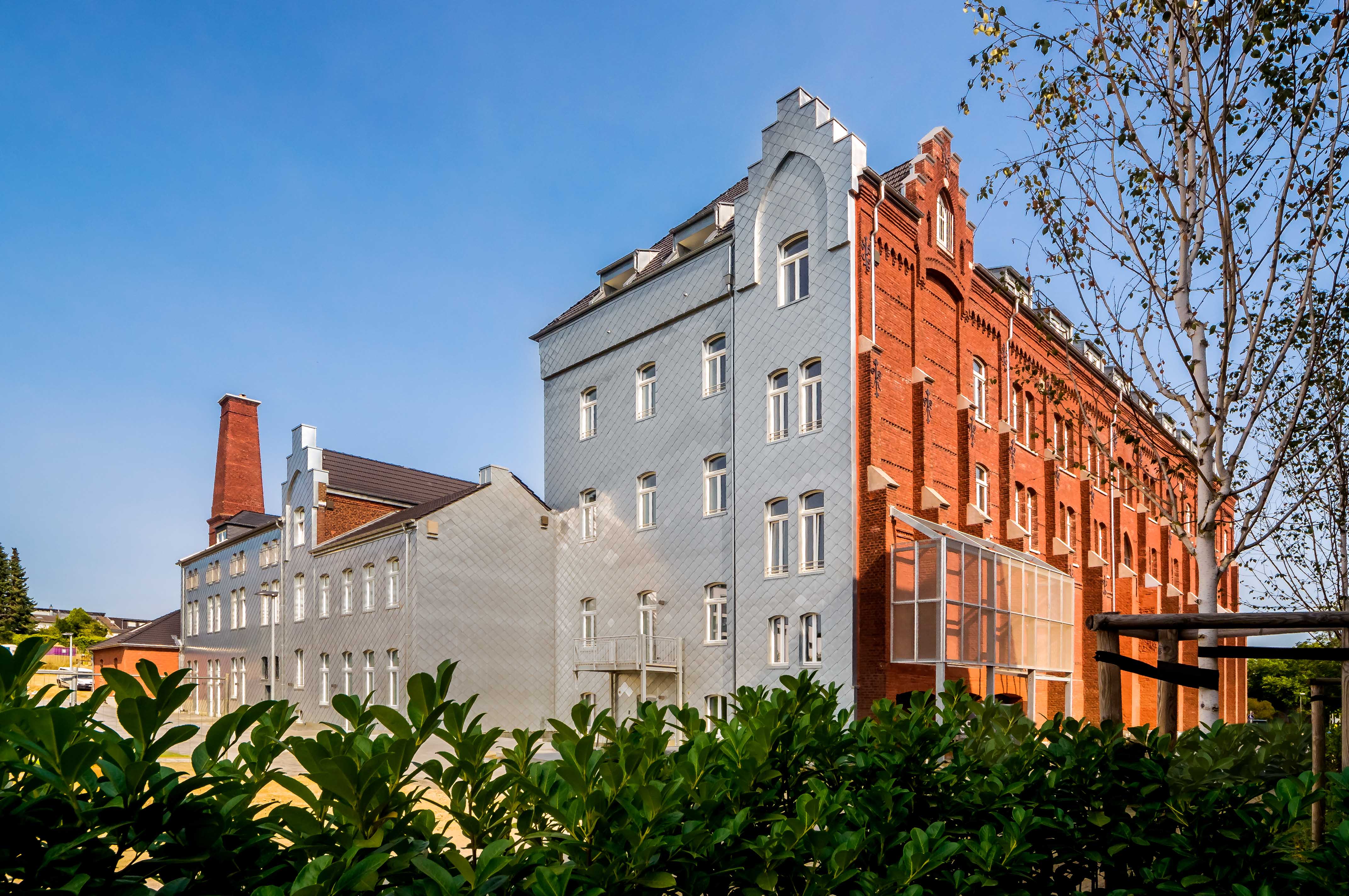
What is often underestimated: your living environment has a direct impact on how well you stick with learning German. If you have to sit down after a long day at university to review vocabulary or do an online exercise for your course, you need a quiet place and a stable internet connection, especially when course materials or placement tests are provided digitally. Anyone living in a noisy or crowded shared apartment quickly realizes how difficult it is to sit down and concentrate for half an hour. A private, furnished apartment can make a real difference here, simply because you don't have to share a desk with others and don't have to be considerate of roommates when you are preparing for a test. At "Guter Hirte" in Aachen-West, a renovated neo-Gothic monastery building from 1886, there are, for example, 71 furnished apartments in various sizes from 19 to 114 square meters, plus high-speed Wi-Fi with 100 Mbit/s and free study rooms in the building if you don't want to work in your own room. The location is convenient for those commuting between lectures, language courses, and home, being about ten minutes from RWTH, Campus Melaten, and the University Hospital. If you are interested in a room or apartment, you can find current prices and available apartment types directly on the apartment page. You can also find more on the topic of living as an international student at Moving to Aachen as an international student: Housing Guide 2026.
Frequently asked questions
Do I have to take a placement test before the German course?
Yes, the placement test is generally mandatory before you can register for a course. It determines which level matches your current proficiency and is held online, so you can complete it conveniently from home. [3].
When do I need to register for German courses at RWTH?
You must register online within a fixed period at the start of the semester. Deadlines are closely tied to the start of the semester, and those who miss them usually have to wait until the next semester. [2].
How much do the German courses at the Language Center cost?
That depends on the chosen course format and scope; the exact current prices can be found on the Language Center's fees page. Compared to private language schools, the courses are usually more affordable for RWTH students. [4].
Can I easily fit the German course into my class schedule?
Yes, the semester courses are specifically designed for students and are intended to be compatible with lecture schedules. Nevertheless, it is worth scheduling the course time in your calendar early on to avoid any conflicts. [1].
More about living at the Good Shepherd